Seeing Something Different from the Start
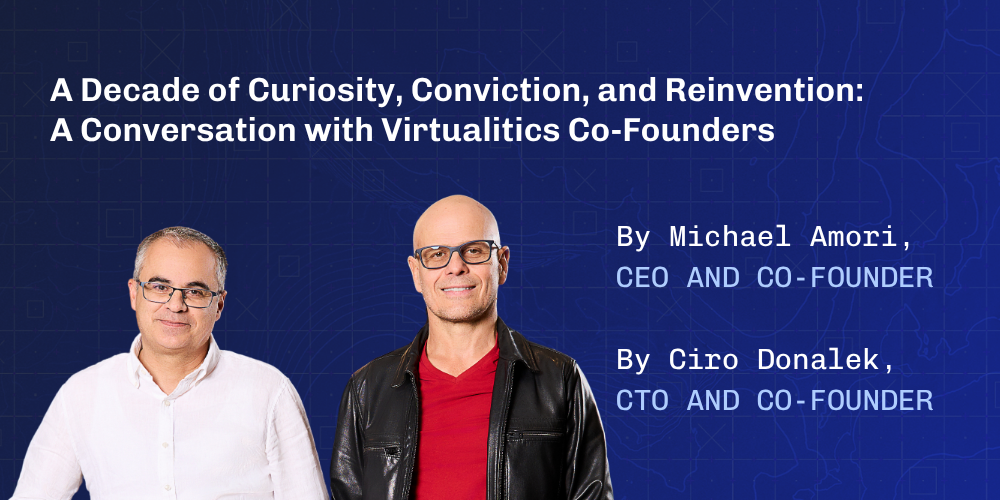
I remember the first time I met Michael Amori and Ciro Donalek. They were in a tiny office in Pasadena hidden behind a bank branch. We approached them with a standard data challenge that we gave to each vendor to assess their mindset for solving complex analytical problems. Michael personally jumped right into the virtual reality workspace and began explaining his perspective on the data. It was an impressive demonstration of personal interest in helping customers.
That level of engagement stood out immediately.
It didn’t take long for that first impression to compound into something more meaningful. As we continued working with the team, that early signal turned into conviction.
It was early within the first year that we had confidence that Virtualitics was unique. The blend of game designers and data scientists was an innovative combination for the moment. My portfolio was stacked with many startups that did one or the other well. Virtualitics was the only one that had a compelling prototype that could reliably derive critical mission insights in an interactive environment that was adaptable to our community.
Building with Aakash Indurkhya and Sarthak Sahu was always an enjoyable experience. The meeting point between subject matter expertise and skilled data science was a combination that we knew the community needed.
The Reality of the Problem
The defense and intelligence communities that shaped my career teach you to be critical of every system and be precise with the analytical process. We had an abundance of data, exquisite capabilities, and an opportunity to implement AI into the problem set for the first time. Doing so required a shift in mindset within the community and a software solution that allowed us to see a deliberate link between our source data and the AI derived insights.
But the real constraint was time. Everything came down to how quicky you could move from data to decision.
My biggest challenge was deciding which problems I had the time to solve before the data lost relevance. A new analytical software solution needed to reduce that time to insight, while maintaining a completely trackable data pedigree.
Many data visualization tools were available, but they only helped us admire the problem. Virtualitics went further.
Moving Beyond “Admiring the Problem”
What we needed was something that could actually move us forward. That meant going beyond visualization and into execution.
Virtualitics went a step further by integrating defense and intelligence expertise with automated AI enabled workflows that could reduce the cognitive burden of the analyst in the mundane data cleaning and triage steps of the cycle and allow us to focus on higher level decision making.
The impact of that shift was immediate. You could feel a difference in how quickly the work translated to action.
Virtualitics took an analyst from a one-to-one return to a one-to-many. This was a monumental shift in the community resulting in higher confidence, increased capacity, and greater mission outcomes. It afforded an opportunity to pre-configure bespoke analytical tasks at the edge of the battlefield. What used to take weeks in post processing could now happen at the speed of war.
From User to Builder
It was an easy choice to join the Virtualitics team when the opportunity was presented. Stepping into the team meant shifting from using the technology to shaping how it gets delivered.
For me, joining Virtualitics to lead the Customer Success team required a mindset shift. The platform had matured from a single use case analyst tool into a fully featured AI platform capable of serving an impressive collection of military personas and use cases. The entire delivery capability needed to be reconfigured to meet this opportunity.
At the same time, the team had to evolve alongside the platform so we built a team the same way we built the product – grounded in mission.
Today, I am proud to show up to work every day with our team of career military professionals that represent an impressive breadth of expertise from aircraft maintenance to strategic planning. Our familiarity with the mission is our differentiator, and our customers love us for it.
Redefining Success
Working closely with customers naturally changes how you think about success.
Customer success can mean different things depending on the industry. In defense and national security contexts, success is mission impact.
You can take away all of the health metrics and industry standard scores. If your product is not answering the call to action in the context of operations, you have failed. We have thoughtfully built our team on core values that align with our customers.
Trusted in High-Stakes Environments
That definition of success brings a different level of responsibility, especially when AI is involved.
In environments where decisions carry real-world consequences, humans always need to be in the OODA loop — Observe, Orient, Decide, Act. There are supporting roles AI can play in each of these phases but the human should always retain primacy. Trust has to be built into the system.
We build this trust by ensuring that the end user has transparency with respect to how and where AI is integrated. Linking a user back to the source record with each AI insight is our policy; one that allows us to maintain trust in the decision-making space.
Leadership That Carries Over
Leadership has a tendency to shift in meaning as one transitions between communities. As a Navy Chief and decade long member of the special forces community, I subscribe to the philosophy that leadership is earned every day.
Now in the role of cultivating capabilities for a broader range of mission centers, I carry that philosophy with me.
For any others considering their transition, I would recommend that they do not undervalue their experience in leadership. Service members are given an incredible opportunity to prove their abilities. The language and scope might change, but the underlying skills are highly desired in the tech sector.