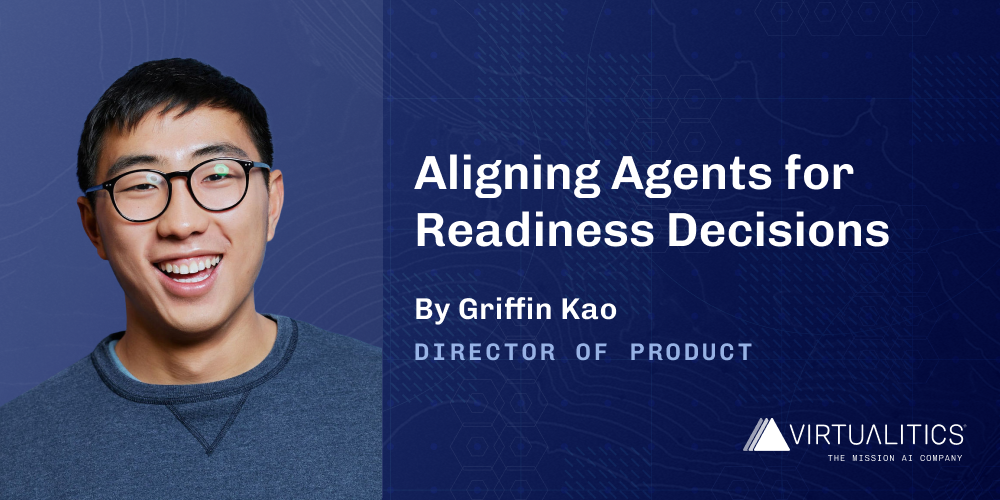
By Griffin Kao, Director of Product at Virtualitics
Imagine a scenario in which a senior leader is trying to decide whether to deploy a specific unit for an emerging mission. They need answers fast:
- What’s the unit’s readiness posture?
- What issues are degrading readiness?
- What would it take to bridge the gaps?
- What other units could support this mission instead?
This isn’t a simple database query. An agent like Virtualitics Iris built specifically for the job retrieves data from multiple systems of record, run analysis to extract meaningful insights, and distill everything into a recommendation the leader can act on. The challenge isn’t just getting an answer—it’s getting the right answer in time to matter.
In our work building mission-critical agents, we’ve learned that defining what “good” looks like is the first step in aligning agents to these high-stakes tasks. Here’s the framework we use to evaluate and optimize agents for readiness decisions.
Four Dimensions of Agent Alignment
1. Capability: Can the agent actually do what’s being asked?
To be useful in specific organizational scenarios, an agent needs access to the right data and tools, the right context and business logic, the intelligence of the underlying models, and the orchestrated agent graph which dictates how tasks get decomposed and routed. As agent builders, we iterate over the factors we can control in order to drive capability. For readiness decisions, oftentimes this means the agent needs to pull from logistics databases, maintenance records, personnel systems, and training data before accessing tools and knowledge which help the agent process the data into concrete calculations or insights like maintenance capacity or readiness levels.
2. Doing the Right Thing: Will the agent follow directions and anticipate needs?
An agent can be highly capable but the outcome can still fail if the agent doesn’t understand what you’re trying to accomplish, stay on task, and anticipate the next objective. This can be tricky especially when a user isn’t explicit with their request. In a readiness scenario, a senior leader might ask, “Can we deploy this unit?” The agent needs to understand that “can we” really means “should we, given constraints X, Y, and Z and potential other options” and surface the trade-offs or other options accordingly. That’s where an AI that’s built for purpose, matters.
3. Trust and Reliability: Can you rely on the output?
This is where calibration and legibility come in. A well-calibrated agent understands the bounds of its own capability. It knows—and discloses—when it’s certain versus when it’s guessing. It surfaces caveats, flags missing data, and keeps the operator in the loop for critical decisions. Legibility means that calibration is inspectable. Can the user trace the agent’s reasoning? Can they see what data was used and what assumptions were made? This needs to be true without the user needing to fully redo the work. For mission-critical decisions, trust isn’t just about accuracy—it’s about transparency.
4. Timeliness: How do you trade speed against verification?
Timeliness is the constraint that cuts across all three dimensions. The cost of every verification step is latency. Every clarifying question costs a round trip with the user. In a readiness decision, waiting three hours for a perfect answer might be worse than getting a good-enough answer in ten minutes with clear caveats. The key is designing agents that optimize for the decision timeline, and agreed “good enough” parameters, not for completeness in a vacuum.
A Note on Security: Security isn’t a dimension you trade against—it’s a hard constraint. Strict role based access controls and least-privilege access are enforced by the system around the agent, not negotiated by the agent itself.
How Virtualitics Acts on This
Customer-Specific Evaluation Sets: We build evaluation sets around this framework tailored to each customer’s mission context. These evaluations test not just accuracy, but whether the agent asks the right questions, surfaces the right caveats, and delivers insights on a timeline that matters.
Purpose-Built Architecture: Our agent and context architecture—the entire harness and user experience—is designed specifically for readiness decisions. The system is built to handle data across multiple security enclaves, optimize for decision timelines, and keep operators in control when it matters most.
Collaborative Discovery: We use this framework as a starting point for every engagement. Instead of delivering a generic “AI solution,” we work with customers to define what capability, reliability, and timeliness mean in their specific operational context. Then we build and optimize against that definition.
Why This Framework Matters
Every customer has a different definition of “good.” Some prioritize speed over precision. Others need full auditability for compliance. This framework gives us a shared language for discovery and collaboration. Instead of debating whether an agent is “smart enough,” we can ask: Is it capable of doing X? Does it anticipate need Y? Can the user trust output Z? This also guides how we optimize agents. When we fine-tune models or adjust orchestration, we’re explicitly trading off between capability, reliability, and timeliness based on the customer’s priorities.
Ultimately, the measure of an AI agent isn’t how intelligent it appears—it’s how effectively it helps people make better decisions. See how we’re putting that principle into practice with Virtualitics Iris.