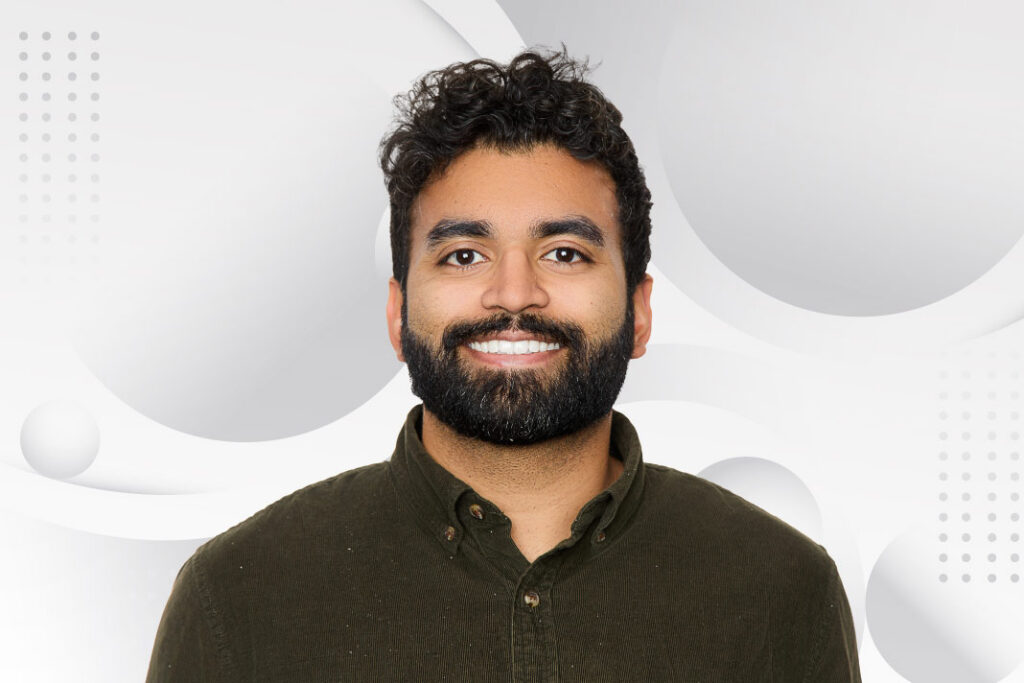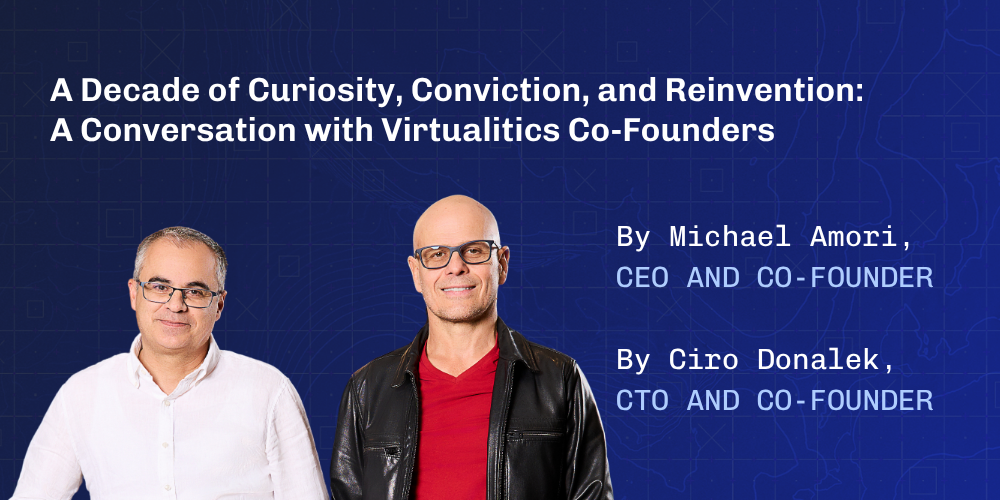
To celebrate Virtualitics’ 10th anniversary, co-founders Michael Amori and Dr. Ciro Donalek sat down to discuss the company’s early days, the lessons learned along the way, and what excites them about the future.
The two of you come from very different backgrounds. How did you end up starting Virtualitics together?
Ciro: It really starts with George Djorgovski.
At Caltech, George brought together people from different disciplines to tackle difficult problems, particularly around machine learning, large-scale data analysis, and visualization. He believed the best breakthroughs happen when different perspectives come together.
Michael and I came from very different backgrounds, but George was convinced we’d work well together and could help bridge the gap between scientific innovation and real-world application.
Looking back, he was right.
Michael: On paper, Ciro and I weren’t an obvious match. We are both from Italy, but Ciro is from Southern Italy and I am from Milan in the north. Some people would think that rivalry alone wouldn’t work. I came from finance and physics, while Ciro was deeply immersed in scientific research and machine learning. But what connected us was a shared belief that there had to be a better way to help people get meaningful insights from increasingly complex data and our love of espresso.
Ciro brought deep technical expertise and a research mindset. I was focused on how technology could solve practical business problems.
That combination ultimately became the foundation of Virtualitics.
What was the original vision for Virtualitics?
Ciro: The original vision was rooted in the work we were doing as researchers. We were dealing with complex, multidimensional datasets and exploring new ways to make them easier to understand.
At the same time, virtual reality was emerging as a promising technology. We started asking whether immersive environments could help people interact with information in entirely new ways.
That’s ultimately where the name Virtualitics came from: “Virtual Reality” and “Analytics.”
What motivated us wasn’t virtual reality itself. It was understanding. We wanted to help people uncover patterns and relationships that were difficult to see using traditional tools.
Michael: From the beginning, we were drawn to hard problems. We believed technology could help people make sense of complexity in ways that weren’t possible before. Our original vision was to build tools that could reveal insights people might otherwise miss.
Every company has a moment where its strategy evolves. What was that moment for Virtualitics?
Michael: It wasn’t one moment. It was a series of conversations with customers.
We thought our biggest innovation was changing how people interacted with data. Customers kept telling us something different – they weren’t asking for better graphics or more immersive experiences, they were trying to answer very practical questions like:
What should I pay attention to?
What’s driving this outcome?
What should I do next?
Ciro: We realized that technology isn’t valuable because it’s innovative, it’s valuable because it helps people make better decisions.
The challenge wasn’t helping people see information differently. It was helping them understand what the information meant and what actions it should drive.
Michael: That realization fundamentally changed our direction.
We shifted from visualization to decision intelligence, from exploring data to helping people act on it. Dashboards are static and show what happened, while Virtualitics shows what’s coming next and helps you understand why.
Looking back, it seems obvious. At the time, it was a difficult decision because it required us to move beyond the thing that originally inspired the company.
But if we’ve learned anything over the last decade, it’s that innovation requires a willingness to challenge your own assumptions.
Was there a point when the mission became especially real?
Michael: Absolutely. We’ve always believed in the work, but there are moments when that belief becomes tangible. For us, one of the moments came during the pandemic.
We were supporting analysis related to the operational impacts of personnel quarantines for the U.S. Air Force. Initially, it looked like a complex modeling challenge.
But very quickly, it became clear that decisions were being made based on the insights being generated.
The timelines were shorter. The consequences were bigger. The need for clarity was immediate.
Ciro: That’s when we saw the real value of the technology. Organizations weren’t looking for more information, they were looking for confidence. They needed to understand risk before it became reality and determine which actions would have the greatest impact. That experience sharpened our focus.
That relationship led to the largest contract we had at that time with the USAF and we still are very proud of the General’s feedback, “Virtualitics created some predictive models…we started tracking their predictions and then we went back and tracked how accurate they were. It was incredibly accurate, certainly more than accurate enough for us to make very timely decisions.”
Michael: We also realized we were addressing a much bigger need. Organizations weren’t looking for another analytics tool. They needed a way to understand risk, evaluate forward looking options, and make decisions with confidence.
When you’re operating in an environment where the stakes are high and uncertainty is unavoidable, clarity becomes incredibly valuable. That’s when we knew we were solving the right problem.
That realization also marked an important turning point for us as a company. Rather than building technology for its own sake, we committed to supporting critical missions by helping leaders see around corners, assess risk, and act with greater confidence. Going all in on readiness wasn’t a departure from our original vision. It was the clearest validation that we were applying our technology to the problems where it could make the greatest difference.
As you look back on the last decade, what are you most proud of, and what gives you confidence about the next one?
Ciro: I’m proud that we’ve stayed true to our sense of curiosity.
The company was born from scientific research and robust data science. We were motivated by a desire to understand difficult problems. Even as we’ve grown, that mindset remains part of our culture.
We still ask hard questions. We still challenge assumptions. We still look for new ways to help people make sense of complexity.
While the technology has changed dramatically over the last decade, the mission hasn’t.
Michael: I couldn’t be more proud of our people.
No company gets to ten years because of two founders. It happens because talented people choose to believe in the mission and help build it.
That includes our employees, customers, partners, advisors, and some incredibly early supporters who believed in us before there was much more than a vision and a handful of ambitious ideas.
What excites me most is that we’re still early. The challenges our customers face today are more complex than they were 10 years ago, and AI is creating possibilities that simply didn’t exist when we started.
Ten years ago, we were trying to help people better understand information. Today, we’re helping leaders understand risk, evaluate options, and act with confidence.
AI has evolved. Technology has changed. The company has grown. But the mission remains remarkably consistent: Advancing frontline readiness and operational certainty through industry-leading AI.
We have a huge opportunity in front of us and in many ways, we’re just getting started.