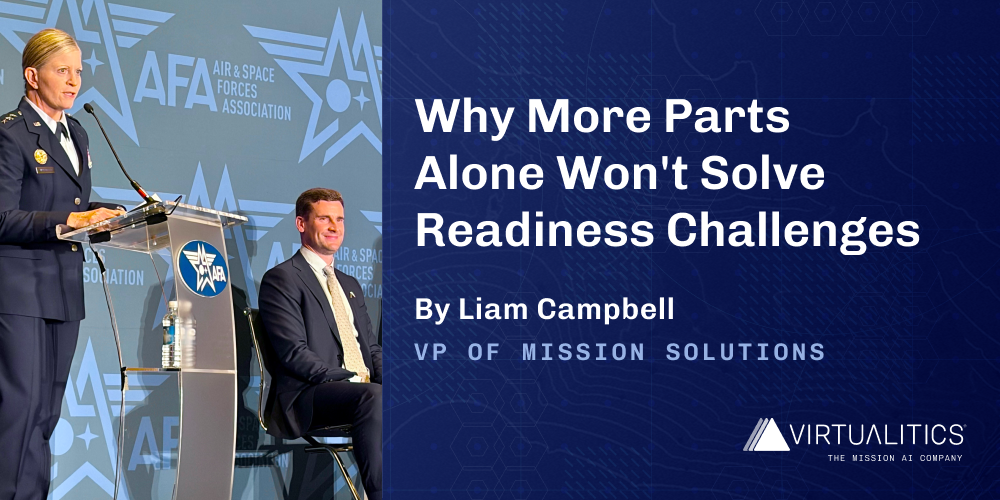
At Air & Space Forces Association’s Air, Space & Cyber Conference, I joined leaders from across the defense ecosystem to discuss one of the military’s most persistent readiness challenges: ensuring the right parts and capabilities are available when and where warfighters need them.
The panel’s title, “Fixing the Force: Spare Parts and Readiness,” might suggest a straightforward solution: if aircraft are waiting on parts, buy more parts and put them on a shelf. But every maintainer, logistician, and supply-chain leader knows the reality is far more complicated. Readiness depends not only on the supply available, but also how effectively we understand future demand, anticipate risk, and act on the information already available to us.
What struck me during the discussion was how interconnected these challenges really are. While spare parts were a focus of the panel, the conversation repeatedly returned to a broader point: readiness is a system-wide challenge that depends on better visibility, stronger coordination, and informed-decision-making across the defense industrial base (DIB).
Below are four takeaways that stood out.
1. Throwing more parts at the problem is not a readiness strategy
The Department of War (DoW) operates with a finite supply footprint. While that footprint can grow over time, the immediate question is what we do with the supply available today.
Answering that question requires a clearer picture of future demand. Some of that demand is known – planned maintenance follows established schedules and operating patterns. The more difficult part is anticipating the unknowns – unscheduled maintenance requirements that emerge without warning and can directly affect mission-capable rates.
Machine-learning models trained on sensor data and historical maintenance records can help build a more complete demand signal. When that forecast is mapped against available supply, leaders can make better decisions about what parts should be positioned where and when. The objective is not to have more stockpile, it is to ensure the available supply is aligned with the mission.
2. The “so what” of data matters more than another dashboard
The DoW is not lacking in data. The challenge is translating that data into clear, defensible decisions.
For years, organizations have invested in tools that show what has already happened. Those capabilities are important, but they only take us so far. We need to move toward predictive insights that identify what is likely to happen and prescriptive recommendations that prioritize action – getting to the “so what.”
A readiness leader should be able to ask: If we deploy these aircraft for a specific period and expect a certain number of flight hours, what should the spares package include? The answer should account not only for planned maintenance, but also for the unscheduled issues most likely to arise.
That is how predictive insight creates decision advantage, giving readiness leaders greater certainty about what is at risk and what to do next.
3. AI delivers value when it helps leaders make better decisions
Understandably, there’s a lot of excitement around AI, but it’s not one-size-fits-all. An AI interface is only as valuable as the intelligence behind it. Before leaders can ask better questions, organizations need predictive models that turn maintenance and supply chain data into actionable forecasts.
Once that foundation exists, AI makes those insights more accessible across the organization. Rather than limiting users to questions anticipated by a dashboard designer, leaders and maintainers can ask mission-specific questions, receive data-supported answers, and explore information in ways that reflect real operational challenges and priorities. AI helps surface risks, identify potential courses of action, and streamline workflows while the operator applies judgement and makes the decision.
It can also bring operational expertise into the system. Maintainers and warfighters hold contextual nuances that rarely show up cleanly in a dataset, so incorporating that expertise is essential to producing recommendations people can trust and use.
4. Readiness must extend across the industrial base
Readiness challenges are not unique to the military. Manufacturers, suppliers and sustainment partners across the DIB face the same fundamental problem: balancing demand with finite resources. That means readiness cannot be optimized within a single organization. At Virtualitics, we have found that capabilities built to support military sustainment and supply-chain readiness can also apply to DIB challenges. Just as importantly, what we learn from industry can improve the capabilities we deliver back to military users. The exchange is a two-way street.
The next frontier of readiness is not another dashboard or an isolated AI experiment. It is a decision environment that connects predictive insight, operational expertise, and workflow execution. When we get that right, complex data becomes trusted decision support, giving leaders the operational certainty to act.