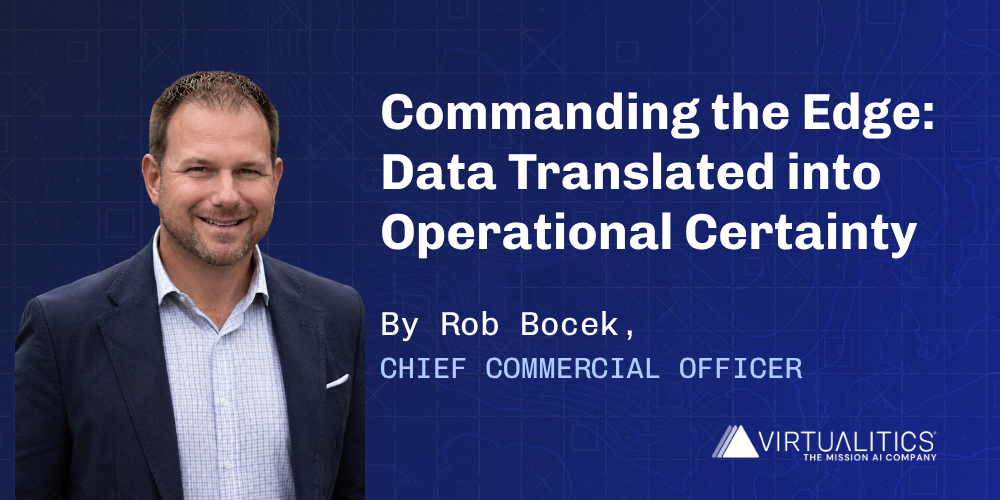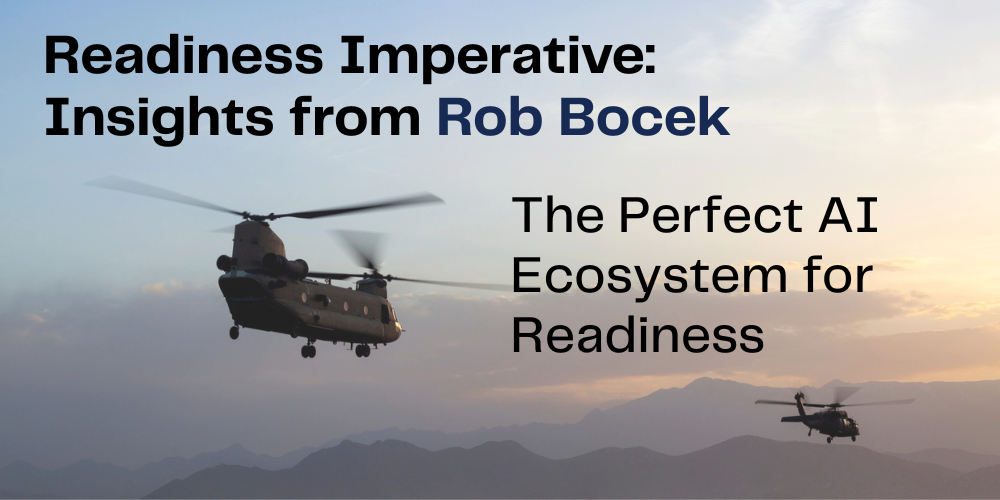
This blog is part of our series, Readiness Imperative: Insights from Rob Bocek, where we unpack the biggest challenges shaping readiness today and how AI can help solve them to make our forces truly mission ready.
Over the last two decades, I’ve watched defense technology transform from the inside-out.
My perspective was forged in combat as an Assault Force Commander in the Navy SEAL Teams, where readiness was a matter of life and death. That foundational experience launched a two-decade journey that has taken me from the battlefield to the boardroom—leading national security teams at Microsoft, scaling advanced weapons and adaptive Command & Control breakthrough capabilities at Epirus & Synexxus, and now pioneering readiness AI here at Virtualitics.
Through it all, one theme has become undeniable: we must evolve the very definition of Readiness to succeed.
This truth came into sharp focus at this year’s Frontiers of AI for Readiness (FAR) Summit, where Caltech academia, government acquisition leaders, and defense tech investors came together to discuss new frontiers and how to better deploy capability to the frontlines. The summit made clear that the future of readiness won’t be unlocked by algorithms alone. (Read a recap of the FAR Summit here.)
It will require the perfect AI ecosystem—an ecosystem built on collaboration, trusted data foundations, and strategic leadership bold enough to champion upstarts who can deliver asymmetric advantages.
Relevance: Adapt, Evolve, or Go Away
AI for readiness cannot reach its full potential alone. No single agency, institution, or vendor has the complete picture. That’s why continuous, collaborative input across government, academia, and industry is vital.
At Virtualitics, we’ve seen firsthand how breakthroughs happen when scientists, operators, mission commanders, legislators, and investors sit at the same table. We are laser-focused on understanding the problem, establishing relevance, and driving adoption in the mission.
Our IRO product, for example, has been shaped not just by our software and data engineers, but by conversations with maintainers on the flight line, acquisition officers navigating contracting pathways, and senior leaders responsible for the War Department’s Total Force Readiness construct—leaders who understand how to scale innovation responsibly.
It’s through these conversations that we were able to see beyond using AI simply for predictive maintenance. Because knowing that something may fail is just one piece—not the entire puzzle and certainly not enough.
What matters is what you do next: What are the second- and third-order effects? How do you get the parts? Are they in contention elsewhere in the supply chain? Do you have the personnel certified and ready on site? What are the logistics trade-offs if you prioritize Asset A over Asset B?
Virtualitics uses these learnings to spotlight the entire decision space so commanders can act decisively, with clarity and confidence. Case in point: When the U.S. Air Force used Virtualitics IRO to evaluate over 1,100 planned maintenance actions for their strategic bomber fleet, it surfaced that 24% of those scheduled jobs weren’t even executable due to part shortages, personnel gaps, or other constraints. That kind of insight would never have been possible without making AI collaboration an integral part of our operations.
Trust: Building the Foundation for AI at Scale
Today, federal agencies are wrestling with siloed, poor-quality data. The result? AI systems that produce fragmented or misleading outputs. In high-stakes defense environments, “black box” predictions are not good enough. Commanders don’t just need to know what might break, they need to understand the cascading effects—parts availability, personnel certification, supply chain trade-offs—before they can act.
That’s why Virtualitics focuses on explainability. We’re seeing junior enlisted airmen using our platform—after a single training event—to query 10 years of data and deliver actionable insights that shape squadron-level operations. And at the other end of the chain of command, general officers are using the same tools to make fleet-level resourcing decisions about asset allocation, sortie generation, and training throughput.
But trust also comes from accessibility. The platform design must be intuitive enough for decision-makers at every level, not just data scientists. When the warfighter trusts the system—and sees it producing results that map to their reality—that’s when AI transforms into readiness intelligence. This is democratizing the use of Mission AI across the force.
Leadership: Courage to Champion Asymmetric Upstarts
The final ingredient is leadership—the kind that’s unafraid to take risks, push through bureaucratic inertia, and back innovative companies that can deliver game-changing capabilities.
Too often, promising AI solutions stall in pilot purgatory, not because they lack merit, but because acquisition pathways default to legacy vendors. But readiness can’t wait. Our adversaries are not standing still. Leaders need to lead by prioritizing decisions that place the mission first and not adopt a wait and see posture.
We need leaders willing to champion asymmetric upstarts—companies agile enough to cut through the complexity and deliver applied AI where it matters most. Having a mission-mode mindset in acquisition means prioritizing outcomes over outputs, moving to contact at the speed of the warfighter, and accepting that risk avoidance can sometimes be riskier than calculated innovation.
At the FAR Summit, we saw leaders who get this—leaders who are leaning into partnerships, not retreating from them. Leaders who can execute on a vision, and not punt to another organization because it’s convenient. They understand that courage at the top accelerates capability throughout the organization.
From Ecosystem to Execution
The perfect defense tech ecosystem doesn’t emerge by accident. It’s built by leaders willing to ask hard questions, demand more from their AI and data, and champion innovation over the status quo. At Virtualitics, we’re not chasing AI hype. We’re building systems that are changing how the War Department sustains and operates some of its most critical assets—daily, decisively, and with real-world mission impact.
This isn’t just about technology. It’s about mindset. It’s about choosing integration over isolation, trust over turbulence, boldness over bureaucracy.
And if we get this right, we’ll operationalize AI in ways that strengthen deterrence, sharpen decision-making, and empower the warfighter to win. That’s the ecosystem our national security demands. And the time for it is now.