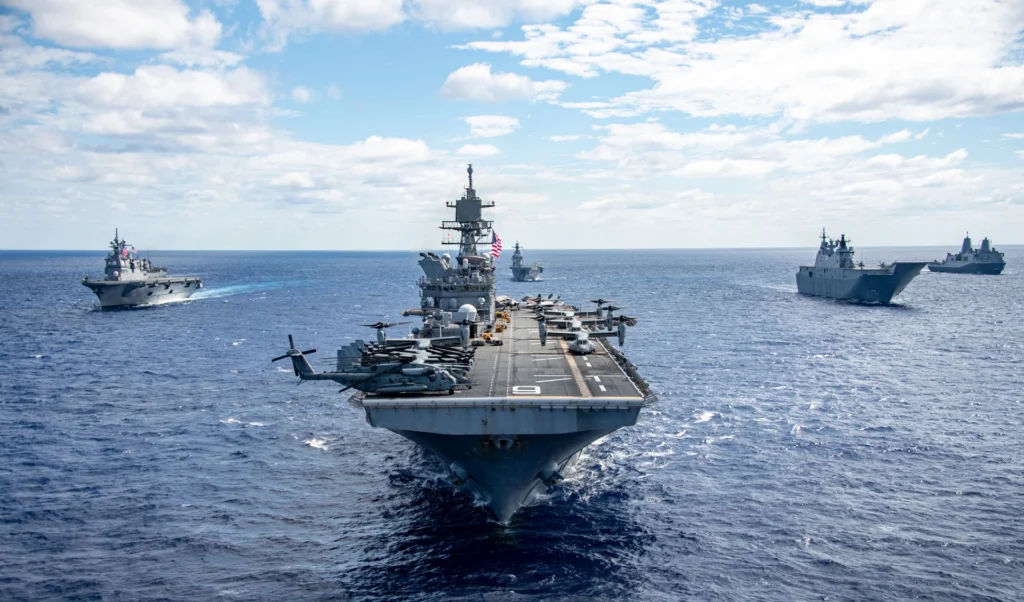
As naval combat power becomes increasingly distributed across manned and unmanned platforms, readiness must be assessed at the system level rather than at the individual platform level. A destroyer’s effectiveness is no longer defined solely by its mechanical readiness, but also by the reliability of data feeds, the health of connected systems, and the resilience of the logistics and industrial supply chains that support it.
These priorities were reinforced across engagements at AFCEA WEST, where Sea Service leaders emphasized that digital integration and cross-domain connectivity are reshaping how readiness and operational risk must be measured, sustained, and scaled. Within this broader strategic context, readiness extends beyond the fleet itself, shifting sustainment to a core element of deterrence rather than a rear-area function. China’s dominant shipbuilding capacity—estimated at nearly 200 times that of the U.S.—combined with its industrial scale, highlights a critical reality: naval readiness is inseparable from the surge capacity of the defense industrial base.
This evolution reframes readiness and risk as a dynamic, interconnected system that demands advanced AI and analytic approaches capable of integrating disparate data sources and generating decision advantage at speed and scale.
How is Naval Readiness Being Redefined at Sea and Beyond?
As the Navy advances toward distributed maritime operations and future warfighting concepts, the data-driven ability to sense, decide, and mitigate risk is becoming as critical as fleet size—and central to maintaining credible deterrence. Autonomous systems represent the next evolution of platform readiness, but they can also introduce new complexities in sustainment, command-and-control, and operational risk management.
Delays in software updates, degraded sensor feeds, component shortages, personnel gaps, or constrained logistics nodes can cascade across multiple operational domains, undermining force availability long before adversary contact.
As autonomy scales across the force, leaders must understand how readiness risks propagate through a system-of-systems in order to prioritize resources and mitigate cascading effects.
Likewise, sustaining high-tempo operations depends on the health of the defense industrial base, including shipyards, suppliers, workforce pipelines, munitions production, transportation networks, and digital infrastructure.
Bottlenecks in any of these areas can erode readiness—and therefore deterrence—faster than adversary action.
Addressing these interdependencies requires deliberate investment in analytic decision support capable of modeling second- and third-order effects in real time under operational and resource constraints. AI-powered analytics solutions such as Virtualitics IRO deliver this visibility by rapidly integrating complex data sources, identifying emerging risks, and prioritizing action to accelerate and inform human decision-making rather than replace it.
When maintenance data, operational usage, and supply chain constraints are analyzed together, the Navy gains the ability to anticipate readiness degradation weeks or months in advance, transforming sustainment from reactive reporting to a source of predictive decision advantage and strengthening deterrence through resilience.
Why Does Human Decision-Making at Operational Speed Matter?
Despite advances in automation and AI, readiness still hinges on human decision-making under uncertainty, too often supported by descriptive dashboards rather than predictive insight. Operators and leaders must make high-stakes decisions rapidly, frequently with incomplete information and competing priorities.
Integrating operational, maintenance, logistics, and industry data into coherent decision frameworks is essential to aligning sustainment actions with mission objectives.
Advanced analytics, mission-tuned AI agents, and AI-driven reasoning provide that connective tissue—transforming fragmented data into predictive insight.
By elevating forward-looking analysis over descriptive dashboards—highlighting risks, trade-offs, and recommended actions—decision-makers can shift from reactive firefighting to proactive risk management aligned with mission and deterrence priorities.
Why Must Naval Readiness Be Viewed Holistically Beyond Platforms?
As naval warfare expands across domains, readiness must be treated holistically as a determinant of both combat effectiveness and strategic credibility. Virtualitics advances this transformation by synthesizing vast cross-domain data into real-time, explainable, decision-ready insight.
In this emerging readiness paradigm, success requires viewing the fleet as an interconnected system rather than a collection of platforms—one where analytic reasoning and human judgment converge to sustain combat power, strengthen deterrence by denial, and secure enduring advantage.