This thematic analysis is part of the AI in Practice series, where Virtualitics experts share perspectives on the evolving role of artificial intelligence in national security.
As government agencies face increasing pressure to deliver more without expanding headcount, artificial intelligence is quickly becoming central to how work gets done.
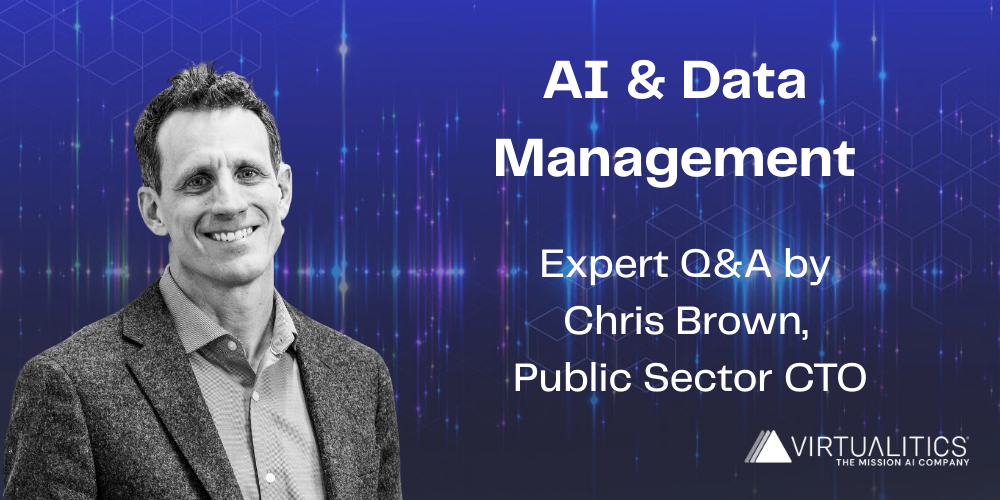
At the Potomac Officers Club AI Summit, leaders across federal agencies and industry discussed what it actually takes to move from AI experimentation to real-world execution. Chris Brown, Public Sector CTO at Virtualitics, joined the panel to share his perspective on how agencies are navigating this shift.
One theme came up repeatedly: adopting AI is not just a technology challenge, it is a transformational change within organizations.
AI Strategy Is No Longer Just an IT Function
For years, agencies approached transformation through discrete strategies—data, cloud, or digital modernization—typically led by IT.
AI changes that model.
Generative AI tools are already in the hands of a broad portion of the workforce, not just technical teams. This means AI strategy must extend beyond IT and account for how employees across the organization interact with, trust, and apply these systems in their daily work.
The challenge is no longer just deploying tools, it’s helping people actually use them.
Rather than asking how AI can automate individual tasks, agencies are asking how it can augment human decision-making, reduce manual effort, and elevate the level of work across the enterprise.
Automation Starts with Human Oversight, Not Full Autonomy
While agentic AI continues to advance, full autonomy is not the near-term goal for most government missions.
In high-stakes environments, such as public health, national security, and defense, human oversight remains essential. AI systems are being deployed to support decision-making, not replace it.
This “human-in-the-loop” model ensures that outputs are validated, context is applied, and accountability remains clear.
The implication is important: successful AI adoption is not about removing humans from the process. It is about designing systems that combine machine speed with human judgment.
Data Still Determines What AI Can Deliver
Despite rapid advancements in models, the limiting factor for AI in government remains data.
Agencies continue to face challenges with fragmented data environments, inconsistent governance, and limited visibility into how data is structured and used. These issues are not new, but AI amplifies their impact.
At the same time, the definition of “data” is expanding. It is no longer limited to structured databases. Unstructured text, documents, and even code bases are now critical inputs for AI systems.
As agencies explore agentic AI and retrieval-based architectures, additional challenges are emerging, such as how to manage and refresh vector embeddings that power these systems.
AI performance still comes down to data readiness, governance, and access.
Governance Must Be Built Into the Architecture
AI introduces new risks that traditional governance models were not designed to handle.
Large language models are non-deterministic, meaning they may produce different outputs for the same input. This requires new approaches to validation, monitoring, and trust.
At the same time, agencies must ensure that sensitive data is protected and that AI systems operate within strict policy boundaries.
The approach we’re seeing is to build governance directly into the architecture:
- Enforcing “secure by default” environments
- Registering Agents in Identity Management Systems
- Applying data loss prevention (DLP) controls
- Restricting access to approved tools and datasets
- Training users on appropriate model usage
- Validating outputs across multiple models when needed
Rather than relying solely on policy documents, governance is increasingly being enforced through code.
The Workforce Is Driving Adoption from the Bottom Up
One of the biggest shifts is where innovation is coming from.
Instead of being driven exclusively by centralized IT teams, many of the most impactful use cases are emerging from the workforce itself. Employees are using AI tools to solve problems in real time—often without waiting for formal development cycles.
This shift is accelerating adoption but also introducing new challenges.
Agencies are responding by investing in:
- Training programs and continuous learning
- AI “champion” or “ambassador” networks
- Shared prompt libraries and best practices
- Guardrails that enable experimentation without compromising security
As AI lowers the barrier to building and deploying solutions, the role of IT is evolving—from builder to enabler.
At the same time, the skills that matter are changing. Technical expertise remains important, but the ability to frame problems, apply context, and ask the right questions is becoming just as critical.
Procurement Models Must Catch Up to the Pace of AI
The speed of AI innovation is exposing limitations in traditional government procurement models.
Time-and-materials contracts often incentivize longer timelines and increased labor, which runs counter to the efficiency gains AI can provide. At the same time, long procurement cycles make it difficult for agencies to adopt rapidly evolving technologies.
Agencies are starting to push toward more flexible, outcome-based models.
This includes:
- Buying against mission outcomes rather than tools
- Breaking projects into smaller, iterative efforts
- Aligning incentives with speed and effectiveness
- Adapting procurement timelines to match industry pace
Without changes to procurement, even the most advanced AI capabilities will struggle to scale.
From Experimentation to Execution
AI is already in use across government, but scaling it takes more than access to models.
It requires reducing friction across the organization:
- Friction in data access and governance
- Friction in security and accreditation processes
- Friction in workforce enablement
- Friction in procurement and deployment
The agencies making the most progress are not necessarily those with the most advanced technology. They are the ones aligning strategy, data, infrastructure, workforce, and governance toward a common goal: delivering outcomes.
That’s what it takes to actually put AI into practice.