Readiness dominated the dialogue at this year’s AFA Air, Space & Cyber Conference, underscoring that emerging technologies, like AI and machine learning, are America’s key to achieving decision superiority.
This reality was best framed during the keynote address of Air Force Chief of Staff, General David Allvin. He described how Operation Midnight Hammer’s success required fully trained Airmen and “more than 100 U.S. aircraft…including the B-2, fourth- and fifth-generation fighters, air refueling tankers, and a full-array of intelligence surveillance and reconnaissance assets.” A critical component of this victory was leveraging AI to increase the service’s aircraft availability and readiness of these assets.
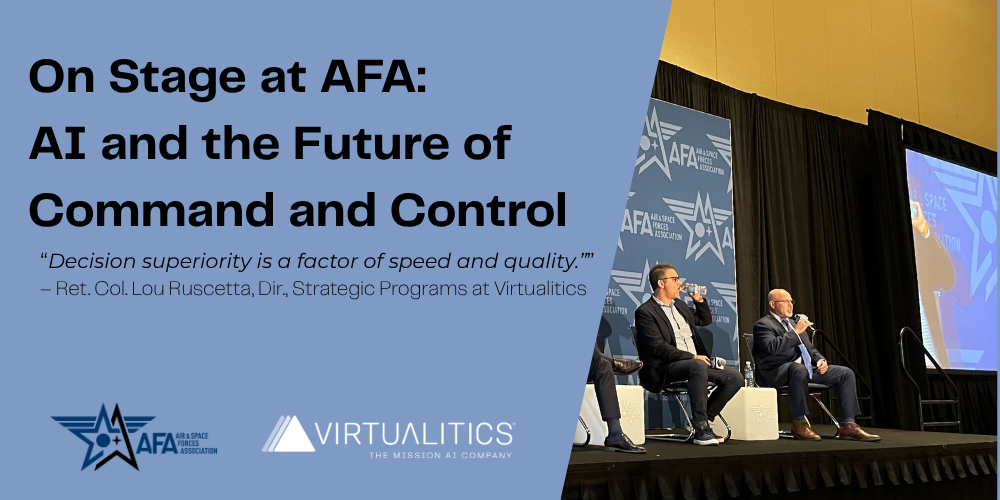
The discussions around the readiness imperative continued during a panel on how AI can help transform command and control (C2), where senior leaders from across government and industry shared key insights on accelerating AI adoption at the speed of conflict.
3 Ways AI Gives the Readiness Edge
The panel discussion emphasized both the promise and the challenges of deploying AI where it matters most: in the high-stakes decisions that define mission success. What emerged were three central themes for defense leaders charting the path ahead:
1. Achieving Operational-Level AI Is The Goal
While AI has already shown promise at the tactical edge—think autonomous vehicles, image recognition, or natural language copilots—the real benefits lie at the operational level. This is where decisions that could win or lose the war are made.
“Decision superiority is a factor of speed and quality,” said Ret. Colonel Lou Ruscetta, Director, Strategic Programs at Virtualitics. “Increasing that speed and quality of the information and the outputs of the AI and ML is the operational goal.”
This is because the complexity of orchestrating forces, synchronizing logistics, and adapting to fast-changing scenarios makes this domain uniquely demanding. While AI will not replace human judgment at this level, it can give leaders the tools to process volumes of operational and tactical data far beyond human capacity.
The value lies in orchestrating chaos by connecting and integrating disparate data (i.e. aircraft status, weapon systems, pilot reports) so that the system can reach out to all those databases for the necessary information. This is where AI will give the U.S. its biggest advantage, ensuring our systems are utilized in a much more effective and efficient manner.
But more than that, it can give commanders better capabilities for assessing degraded environments, recomputing missions in real time, and keeping logistics flowing under fire. This shift isn’t just evolutionary; it’s potentially decisive in battle.
2. Moving From Models to Workflows and Agents
It’s critical that operators move from knowledge to action, which is why the future of C2 is in AI-enabled workflows that can react autonomously, directed or undirected, amid battlefield chaos.
While most AI progress so far has been in models, the next phase is in the infrastructure and orchestration—taking the models and embedding them into workflows with the right permissions and integrations.
We’ll also soon see more directed copilots and AI agents talking to other agents. However, these digital assistants will be ineffective without integration into existing command chains, secure networks, and mission workflows. To achieve this, commanders and operators need to invest in infrastructure, experimentation, and change management.
3. Trust is the Foundation of Adoption
The biggest barrier to AI integration isn’t technology—it’s trust. Decision-makers are held accountable for outcomes, and since they can’t hold an algorithm accountable, they must be able to trust its output completely so they can act on it.
To achieve this, the “black box” around AI needs to be lifted using explainability. Virtualitics leverages Explainable AI (XAI), which is a set of processes and methods wherein human users can understand and trust the results from machine learning algorithms.
Ruscetta highlighted trust as the “foundation” of AI adoption. He went on to emphasize that trust is built by empowering the user: giving them the ability to see precisely how data is being used and produced, question the AI’s output, and immediately review the explanation the algorithm provides. He further elaborated that the true measure of this trust is adoption: when Airmen and Guardians begin using AI on their own, and that usage continues to increase.
Virtualitics’ experience deploying XAI to synchronize maintenance activities across the B-1, B-2, and B-52 platforms shows that this transparency is crucial for earning assurance —and adoption—from commanders and policymakers.
“As [AI] becomes more in our lives…we will interact with it more, and therefore it won’t be as unique in the fight. It will be just another portion of our lives that happens to happen in the fight,” said Col. Ryan T. “Ape” Hayde, Commander of the 505th Command and Control Wing.
Organizing Chaos: The Future of AI in C2
Today’s human capacity is already constrained. Tomorrow’s AI-enabled systems could seamlessly integrate data across platforms, logistics nodes, and missions to recommend courses of action in seconds.
This is where AI may prove decisive. By offloading administrative tasks, processing degraded data, and offering commanders the “best unified readiness picture” available, AI can help the U.S. achieve decision superiority in contested environments. The edge will not come from machines replacing commanders—it will come from machines enabling commanders to outsmart, outpace, and outperform adversaries.