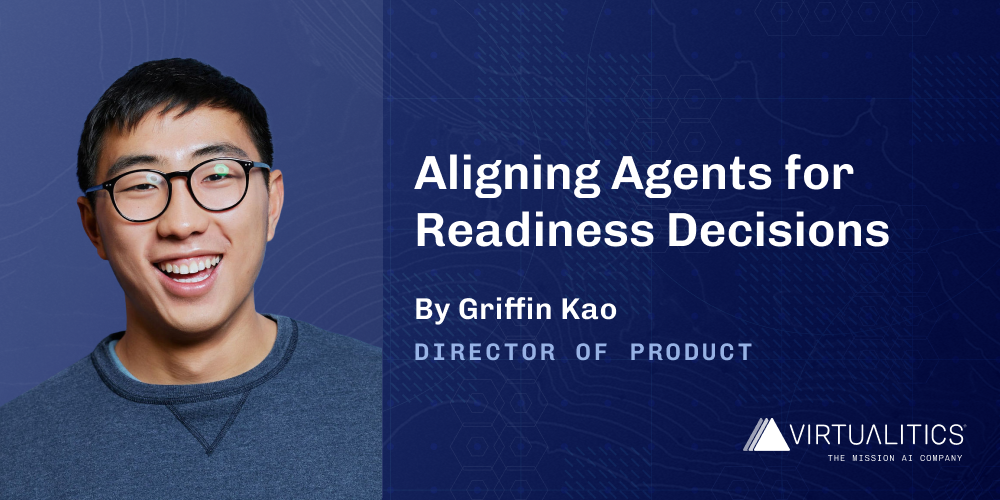
By Griffin Kao, Director of Product at Virtualitics
Why AI-Added Became the Default
Most enterprise software companies first encounter AI as a feature request. A sales team wants a chatbot. A product manager wants automated summaries. An executive wants dashboards that can answer questions.
The fastest path is to layer AI on top of what already exists. These AI-added features often deliver real value, especially when tasks are discrete and human initiated. At this stage, the underlying architecture often doesn’t matter much. When AI is confined to summarization, question-answering, or content generation, teams can move quickly without rethinking their core systems.
But as organizations push beyond isolated features toward systems that can reason, plan, and act continuously, limitations emerge. The underlying architectures were designed for humans, not agents. What works at the margins begins to break at the core. The challenge isn’t a lack of ambition; it’s that systems designed for human use were never meant to support agents as participants.
Agent Architecture is a Mission Readiness Issue
The friction that appears when building agents on top of human-centric platforms isn’t accidental, it’s structural. The friction emerges from two directions. How data is presented to agents, and the kind of work agents are implicitly allowed to perform.
First, human-optimized interfaces create noise for agents. Data presented through modals, dashboards, and visual abstractions is intuitive for people but ambiguous for systems that need clean schemas and unambiguous context. For agents, this “context pollution” directly degrades reasoning quality and output consistency.
Second, existing use cases impose an invisible ceiling. When agents are constrained to workflows designed for humans, they’re limited to tasks a human could perform — just faster. But agents are not simply faster humans. Their value emerges when they monitor continuously, detect emerging risk, and surface insights before failure occurs — capabilities that don’t map cleanly to traditional UIs.
In high consequence environments, these limitations directly affect readiness, trust, and operational certainty. Systems that fail quietly at scale erode confidence far faster than systems that fail loudly and early.
Task Agents vs. Domain Agents
As we worked through these challenges, a useful distinction emerged.
Task agents are aligned to well-defined tasks and can be deployed broadly with minimal customization. Their outcomes are often verifiable, making evaluation straightforward. Many early AI agents fall into this category.
Domain agents, by contrast, require deep institutional context. They must reflect an organization’s data architecture, terminology, processes, risk tolerance, and decision authority. A domain agent serving a federal organization isn’t just performing a function — it’s operating within a specific institutional reality. These agents must be able to adapt, prioritize, and make tradeoffs within that context, not simply follow scripts.
This distinction mirrors traditional enterprise software: generic tools are easy to replicate; deeply embedded, context-rich deployments are not.
Why Data and Domain Context Become Prerequisites
In human workflows, imperfect data is an inconvenience. In agent-driven systems, it compounds at scale. Errors that affect a single user in human workflows can propagate across thousands of agent invocations; compounding quickly and invisibly.
Clean systems of record, well-structured APIs, and documented business rules are no longer hygiene factors — they are prerequisites for reliability. When deploying fleets of agents, small ambiguities propagate quickly and can undermine trust across the system.
This is why investments in data integration and domain context matter more, not less, as AI becomes more autonomous.
What an Agent–Native Platform Looks Like
Shifting to an agent-native architecture isn’t about swapping components. It’s about changing what the system is optimized for.
Many of the components that become first-class in an agent-native system – memory, context engineering, orchestration, semantic layers aren’t new ideas. What’s new is treating them as the foundation rather than afterthoughts.
In an agent-native platform:
- Agents are services that can be invoked by users, events, or schedules — not just chat interfaces.
- Outputs are grounded, explainable, and reusable across contexts.
- Agents can operate proactively, surfacing insights at critical moments rather than waiting for prompts.
This translates into a layered approach:
- Data and context as the foundation.
- Agent tools, orchestration, and serving as core infrastructure.
- User interaction designed to support human-AI teaming, review, and accountability.
Smart Moves to Consider
- Pressure-test whether your AI roadmap assumes agents can thrive on human-centric platforms.
- Invest early in data structure and domain context — these decisions compound.
- Evaluate AI systems not just on feature performance, but on their ability to support readiness and sustained operations.
Final Thoughts
The real question isn’t whether AI can automate individual tasks. It’s what becomes possible when coordinated domain agents operate with shared context — executing workflows no human team could realistically sustain.
Reaching that frontier requires architecture designed for agents from the start. That’s the shift from AI-added to agent-native — and it’s where enterprise AI begins to deliver durable, readiness-driven value.